Monday, June 24, 2013

How many objects is enough? Digital assets and scale.


The Europeana project is a tremendous undertaking allowing access to “millions of items from a range of Europe's leading galleries, libraries, archives and museums.” The collections are language interdependent – since the portal is available in all eu languages, with on-the fly translation. To accomplish this project there has been a massive amount of work on rights, standards, and data normalization. The site presents access to a shared cultural heritage, serving both political and social purposes.

But how does scale affect the presentation and use of digital content? Working on a collection of 700+ objects for the Mount Vernon midden project I have to wonder at the pros and cons of such vastly different projects. It seems almost silly to compare them  - and obviously there are many, many aspects to the Europeana project - but as a visitor to the sites, how do they serve their audiences?
I know the curatorial work that has gone in to the Mount Vernon midden project. Recognizing that it’s an archaeological assemblage, where context is always primary, the objects there have to been seen within the larger framework: the reciprocal links from objects to themes, and items; the linked excavation layers; the linked related primary documents; the historical and archaeological background. If these items were aggregated to a common site much would be lost. It’s the context that informs the objects, giving meaning within the framework of the whole carefully constructed site.

A key part of the Europeana site is the development of a common standard allowing sharing and collaboration. But what is lost when we reduce objects to a common core? I’m still working through the CIDOC CRM standard, (understanding it to be more concerned with relationships than fields). Oldman lucidly argues in his recent blog (Oldman & Doerr, 2013)/, that aggregation through core fields is a misplaced goal. He sees a better approach in a richer CRM standard, publishable through aggregation format, noting in broad terms the loss of context and meaning as objects are moved away from their curatorial origins. [Readers interested in questions of scale in digital media will find a more thorough and informed exploration in Oldman's blogs!]

The Europeana API potentially allows museums to link back to the Europeana collections, though I didn’t see this implemented. If I’m looking at a beautiful agateware teapot in the Fitzwilliam museum, I’d like the option to see similar examples. It seems there still a way to go in the implementation of the tools.  For the Europeana exhibits, though the content and presentation was great, what I wanted was a way to expand the content. Perhaps I missed the feature but why, with millions of objects available, am I limited within the exhibit to those selected for me? I understand providing a narrative, but can’t a layered experience be provided that allows visitors to go further into the collections, to add their own objects? 

The Europeana project is a tremendous undertaking, and the use of common standards leads to long-term benefits for sharing and collaboration. But when we visit a museum there’s a conscious and unconscious preparation. "Normally the physical museum serves as a context, where various properties of buildings, rooms, exhibitions and other features are border resources.” (Nilsson 1997). Digital content experienced through a web browser starts as a reductive experience. It’s important, I think, to compensate for this loss with as richly contextualized environment as possible.

Links and citations:

Europeana - Homepage. (2013). Retrieved June 24, 2013, from http://www.europeana.eu/
Nilsson, T. (1997). The interface of a museum: Text, context and hypertext in a performance setting. In ICHIM 97: international conference on hypermedia and interactivity in museums (pp. 146-153).
Oldman, D., & Doerr, M. (2013). The Costs of Cultural Heritage Data Services: The CIDOC CRM or Aggregator formats? Retrieved from http://www.oldman.me.uk/blog/costsofculturalheritage/


Monday, June 17, 2013

New blog. New purpose


The Stories Past blog has languished over the last few years. This has largely been because I’ve been working part-time outside of the company as a research assistant at the University of Tennessee, serving as the PI on the new web catalog for the National Park Service. It has been a great project; we’ve redesigned the website and worked with parks to add content. The site currently boasts over 2 million objects and site traffic has increased tenfold.

National Park Service Web Catalog

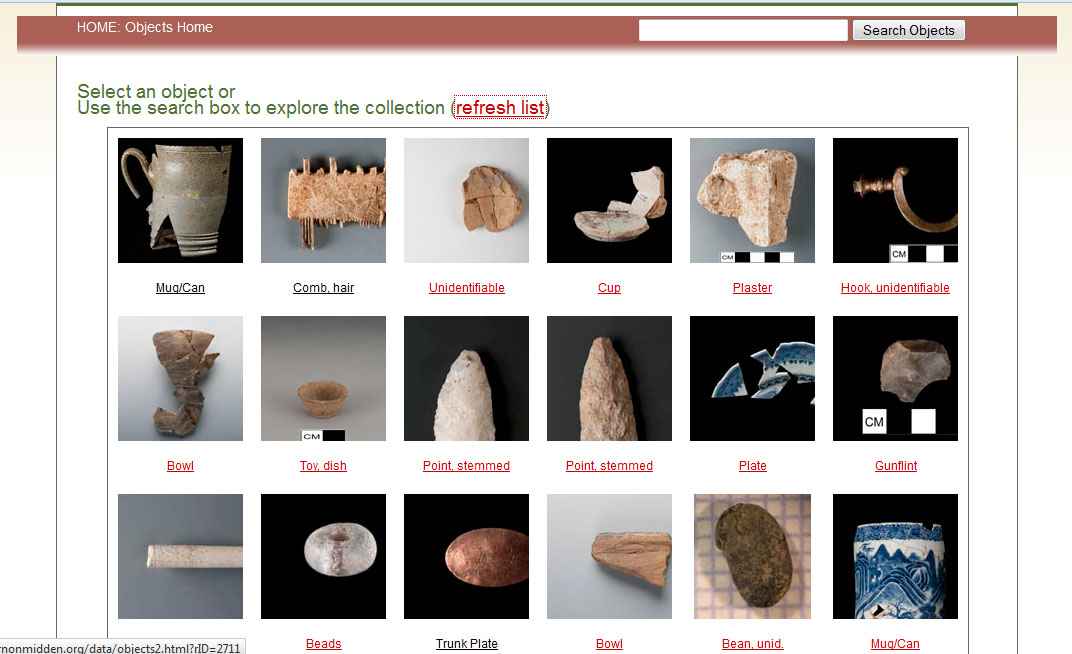
Stories Past has continued to work with different clients, including the Mount Vernon Midden site. In contrast to the NPS site this project has just 700 objects, each very well described, with accompanying images, and presented in a rich thematic context. The site also integrates two documentary databases relating the archaeology objects to the documentary record.

Mount Vernon midden site
Personally I have undertaken a new venture as well. I’m part way through a Master’s of Information Science program at the University of Tennessee. It has exposed me to a much wider range of materials,  and allowed me to read and research topics outside of immediate project needs.

I’m currently researching and exploring issues of online collections encompassing archival, museum and archaeological materials. I started my career as a teacher and my interest is in how these now digital assets can serve the many “public” audiences. My private aim for this blog is that will serve as my “deadline” – a weekly post on the issues with which I’ve been wrestling. Hopefully it can serve a wider purpose as well, discussing issues and providing examples of some great sites and links to resources.

The next blog will be considering scale. Are we best served by aggregated collections of millions of objects from multiple institutions? Or is a better model well-described (and exposed) collections presented within the rich thematic context?

Tuesday, September 20, 2011

More fun to be had in the exhibit hall


I’m sure there were some great papers at the AASLH conference, but I spent my time in the exhibit hall. Most people wander through at some point, and I had the unexpected pleasure of meetings some old friends. 

So rather than talk about papers I’ll talk about neighbors! I’ve been following the work of Eduweb   for years and they’ve done some great stuff.  One of the great things they been doing is putting some resources into finding out what works. Check out the research papers at their site.

Opposite me was The Museum Bookmark Collection.  Their graphics and production quality were great. So good in fact that while I chatted across the room someone came up to my booth, ignored my material, and took the sample bookmarks I’d collected earlier!

Kapesni is on a mission to get mobile apps everywhere, and they have a very competitive pricing model. I think the current app is for iPhone with the Android app coming in a September.

Around the corner was Re:discovery  (where I worked for many years). Rediscovery is providing the back end of the upcoming NPS web catalog site which is getting some early testing. I’m very excited by the progress and early reactions. Plus they have an updated version of their archaeology module which is hierarchical, content rich and full of features.

Thanks to everyone that stopped by and chatted!

Tuesday, September 6, 2011

Putting the cart before the virtual horse

I’ll be attending the AASLH conference in Richmond this month. Many of our clients are in Virginia and I look forward to catching up, and meeting also new faces. 

The conference includes a focus on “Take(ing)  advantage of the constantly emerging technologies that have the potential to enable us to increase access to history experiences”

Stories Past has been working on interactive media for over ten years now. (btw check out Google’s page on browser development ). We’re now developing using AJAX, looking at HTML 5 and using Adobe Flash for some other applications. 

The danger with new and exciting technologies is that it’s sometimes possible to put the cart before the horse. The issue, I think, is less what can the new technologies offer, and more what do we want to do. We can now develop more quickly; we can incorporate databases, animations and media. But the start of a project is the public outreach/education that you want to achieve. Then we’ll find the best way of doing it. I believe the strength of Stories Past is in its empathy and understanding of history, archaeology and education. 

The good news is just virtually anything is possible.

Monday, August 29, 2011

"You've Got Mail"


I watched “You’ve got mail” last week. The movie came out in 1998 and the ironies were writ large when on Saturday I went to the Borders closing sale. We bought fourteen technologically redundant books for a little over a $100. The big box bookstores (like AOL itself) are now threatened into extinction by e-books and online retailers.

One of the books I purchased was Your Digital Afterlife – an examination of what happens to digital assets after death. I wonder if Tom Hanks and Meg Ryan archived their email romance, or if all those love letters were lost in the ether. Today they’d be on a dating site, or tweeting, and I suspect their electronic exchanges would be even more ephemeral.   When I was in college I got and sent letters from friends. These hand-written missives were much longer, and more considered, than the emails, or Facebook posts I get now. They’re in a box in a cupboard - not that paper is the perfect archival material. 

As a developer I’m both intrigued and worried by the pace of change. Now its mobile applications; clearly the predominant tool for the under 30’s. Are we reducing complexity, or are the small screens just another challenge. Social is the new Flash, and everyone is famous for 140 characters. We can say it, show it and play it, but we’re still working out exactly how we understand it all.

As we were leaving the bookstore Saturday we passed a sign. LP’s $1. I bought 7, all from bands in the 70’s and 80’s. Nice to hold an album, and be able to appreciate the cover art. Does anyone listen to albums anymore, or just downloadable “singles.” Now where can I buy a record player…

Friday, July 22, 2011

SHA 2012 part II


At the SHA meeting in Baltimore I’ll be hosting a round table session:
Web Based Public Archaeology
This roundtable discussion examines the different ways archaeologists are using websites and social media to promote archaeology. Please come with some great examples to share and discuss.
Some examples I've recently seen or been involved with:
Transitions in Virginia Slavery: part of the project funded by NEH and carried out by Dr. Barbara Heath of the University of Tennessee. We'll be adding some educational content to the web site soon.
Mount Vernon's Midden blog and Facebook presence have been well followed and full of good stuff with the new web site in progress.

Also I've also recently come across Close Encounters of the Colchester Kind...

Not just archeology, but the Park Service web catalog site is progressing. You can read about it at here.

Obviously there are many others. Please add some examples and comments below!

How effective are they? Is there a conflict between the blogger's voice and the institutional voice? Is the immediacy of blogging at odds with serious research? Is there a public audience for primary archaeological data?

Discuss!!!

Monday, July 11, 2011

SHA 2012


New NPS collections web site
The lack of blogging has been due to too much going on rather than too little! But I hope I can share projects and other news over the next few months.

July always seems early to be thinking about a January conference, but the Society for Historical Archaeology conference in Baltimore had its deadline for submissions yesterday… . My topic will be “Online archaeology databases and the public” and I mean to talk about the new NPS website, as well as other online catalogs. The Mount Vernon site - 400 extremely well described objects, in a rich context – makes a great contrast. Which is more useful to the public?

There was a great technical leaflet in the AASLH publication” Designing Education Programs that Connect Students to Collections”. It focuses on planning educational content around objects, but I think much of it applies to online collections. The national educational curriculum is doing little to help the social sciences. And unless you want to appeal to a purely local audience the different state standards make creating lessons plans difficult. It is mentioned here - and I discovered this many years ago with the Jamestown modules - it useful to look at the English learning standards which are more focused on reading for understanding than the History ones which, at least in Virginia tend to be more fact based. 

I’d be interested in anyone has site or articles looking at using online collections.